ISSUES
International Researchers
Protecting the Rights of International Researchers
International scholars have always faced challenges and precarity on account of our status as visa holders. In 2020, the federal government increased the pressure on visa-holders by issuing a number of short-sighted and xenophobic policies, from requiring international students to attend classes in person during the COVID-19 crisis or risk deportation, to restricting H1B visas, to the Muslim travel ban, to restrictions on Chinese international scholar visas, and more. These actions have created tremendous stress, concern and uncertainty for international researchers and our futures.
The precarious position international scholars face can also compound the many sources of stress we experience as researchers working at Sinai, from New York City’s ’s high cost of living and lack of affordable housing, to insufficient family-friendly benefits, and can leave many of us without options when faced with unfair termination, unreasonable work expectations, or harassment.
By forming a union, international researchers can negotiate for additional protections. Through their contracts, for example, UC Postdocs have won increased rights for international postdocs by ending UC’s practice of denying health benefits for many international postdocs and ensuring equal treatment regardless of immigration status.
In addition to new rights and economic improvements that often uniquely benefit international workers, Columbia University Postdocs and Associate Research Scholars also won increased job stability by guaranteeing that appointments must be held open for at least 60 days if work authorization is delayed, paid time off for immigration-related proceedings, greater ability to work remotely if unable to return to the US, and enforceable protections against discrimination and harassment. In their first contract, Mount Sinai postdocs won an option for extended DS2019 work authorization beyond a postdoc’s appointment length, protected time off for visa renewal, and up to $1,250 in reimbursements for visa-related expenses.
The UAW has also been a critical resource and provided a political voice for international students and scholars to affect national policy. UAW Academic Workers have used their collective strength to:
-
- write thousands of letters to elected officials
- protest outside of ICE offices and share our stories with the press
- host information sessions with immigration attorneys
- and submit formal declarations filed in lawsuits to overturn xenophobic policies
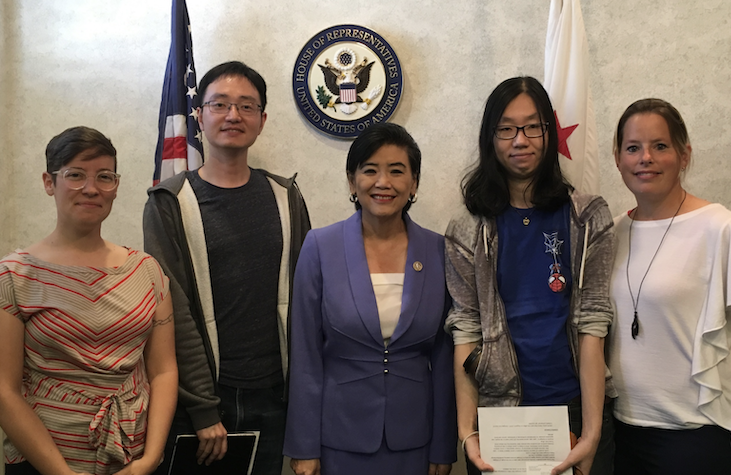
UAW Local 2865 and UAW 5810 union members with Congresswoman Judy Chu discussing her Dear Colleague Letter in support of Chinese international students at her office in Pasadena, 2018
In October of 2020, UAW Academic Workers mobilized against a proposed rule by ICE to shorten visa stays for international scholars; thousands of public comments were submitted, including by the President of the UAW International. In July of 2020, thanks to the direct action by UAW Academic Workers across the country, in addition to efforts by our university and government allies, ICE backed down from its directive to deport international students taking online classes due to COVID-19. In 2017, the UAW International filed an amicus brief in the Supreme Court case challenging the Trump administration’s travel ban.
Nationally, the UAW represents more than 100,000 workers in higher education, a powerful force for effective lobbying. Working with members of Congress, UAW academic workers helped win the Optional Practical Training STEM extension. UAW Locals 5810, 2865 and 4121 representing Postdocs and Student Workers in Washington and California also worked with Congressional Representatives Judy Chu and Pramila Jayapal on a Dear Colleague letter demanding that Secretary of State Pompeo restore the validity period of Chinese international students’ entry visas from 12 months back to 60 months.
Science Funding
Science Funding Advocacy
By forming a union, Sinai researchers can more effectively advocate for increased funding for science and research on the state and federal level by joining with researchers at Columbia University, Mount Sinai, Weill Cornell Medicine, Albert Einstein College of Medicine and New York University in NYC, as well as the University of California, University of Washington, University of Connecticut, and University of Massachusetts, and with graduate employees at the the same institutions and others. For all of us there is a direct connection between federal support for education and research and our career progress, wages, benefits and job security.
Already, UAW Academic Workers are in regular contact with state legislators and members of Congress, educating them on the issues we face and our positions on various legislation. In addition to lobbying for research funding, UAW Academic Workers were also instrumental in securing the inclusion of Postdocs in federal overtime regulations and turning back the Grad Tax.
Most recently, UAW Academic Workers across the country mounted a joint campaign to call for increased research funding in light of COVID-19, to support the ability of universities to emerge from the crisis and continue performing leading-edge research. In April 2020, the President of the UAW wrote to Congressional leadership urging action to protect researchers and research funding in the wake of the COVID-19 crisis, while unionized academic workers like the Columbia Postdocs (UAW Local 4100) called on local representatives for increased funding support. These were among the demands to Congress:
Increased federal funding to NIH, NSF, DOE, NASA, USDA and other agencies to keep research going until operations return to full speed, including maintaining all lab personnel.
More early-career funding, including extension of existing fellowships and increased fellowships available.
The UAW was proud to be a national sponsor of the March for Science. On April 22, 2017 UAW members joined tens of thousands of scientists and science supporters in more than 600 cities around the world to advocate for the protection of science and science funding. We marched because science is critical to our health, economies, food security, and safety. We marched to defend the role of science in policy and society. At Columbia University as well as across the country, researchers participated in one of the largest national days of action to support and protect science funding.